

Divi vs Elementor Pro in 2026: Which WordPress Page Builder Fits Your Workflow?
Choosing between Divi vs Elementor Pro in 2026 is less about finding the “best” page builder in isolation and more about choosing the builder that matches your website type, development process, client workflow, and long-term maintenance plan. Both tools can create professional WordPress websites without writing every template from scratch, but they approach design systems, theme building, WooCommerce customization, and extensibility in different ways.
This WordPress page builder comparison is written for site owners, freelancers, agencies, WooCommerce builders, and WordPress developers who want a practical answer. You will see where Divi Builder is strong, where Elementor Pro is stronger, what to watch out for, and which option makes more sense for real-world projects in 2026.
Quick Verdict: Divi Builder or Elementor Pro?
If you want a polished visual builder with a unified theme-and-builder ecosystem, Divi remains a strong choice. It is especially attractive for designers who like working inside one controlled design environment and for agencies already committed to Elegant Themes.
If you want broader plugin compatibility, a larger third-party ecosystem, more flexible dynamic content workflows, and stronger integration options for custom WordPress builds, Elementor Pro is usually the safer choice. For many professional sites, especially those using custom fields, WooCommerce, forms, marketing tools, and template kits, Elementor Pro offers more room to scale.
For users building advanced Elementor-based sites with custom frontend editing, the ACF Frontend Pro For Elementor plugin is a practical add-on to consider. BanglaDock offers it as a 100% clean, virus-free premium GPL alternative at an affordable price of ৳490 with lifetime updates, making it useful for developers who need ACF-powered frontend forms without paying full commercial pricing.
Divi Builder Review: Strengths, Weaknesses, and Ideal Use Cases
A fair Divi builder review starts with its biggest advantage: Divi is not only a page builder. It is part of a complete design ecosystem that includes the Divi theme, visual builder, global elements, layouts, theme building features, and a large library of premade designs. That makes it appealing for users who want one vendor, one interface, and one design language.
Where Divi Performs Well
- Visual design control: Divi gives designers a highly visual editing experience with modules, responsive controls, spacing options, and global design settings.
- All-in-one ecosystem: The Divi theme and builder are tightly connected, which can reduce decision fatigue for non-technical users.
- Reusable layouts: Agencies can save sections, rows, modules, and global elements for repeated use across client sites.
- Design consistency: Global presets and theme-level controls help keep typography, colors, and modules aligned.
Where Divi Can Feel Limiting
Divi can be less flexible when your project depends on a wider plugin ecosystem, complex dynamic content, or advanced custom field workflows. Developers who build membership portals, directories, frontend dashboards, or deeply customized WooCommerce templates may find Elementor Pro’s integration ecosystem easier to extend.
Divi also has a learning curve of its own. Its interface is visual, but visual does not always mean simple. Clients may need training to avoid accidentally disrupting spacing, responsive settings, or global modules.
Elementor Pro Review: Why It Remains Popular in 2026
Elementor Pro continues to be one of the most widely adopted WordPress page builders because it balances visual design with developer-friendly extensibility. Its interface is approachable for beginners, but its widget ecosystem, dynamic tags, theme builder, popup builder, WooCommerce widgets, and third-party integrations make it suitable for more complex websites.
Elementor Pro’s Key Advantages
- Flexible WordPress theme builder: Elementor Pro allows you to create custom headers, footers, archive templates, single post layouts, WooCommerce templates, and conditional display rules.
- Large plugin ecosystem: Many WordPress plugins, template kits, and marketing tools are built with Elementor support in mind.
- Dynamic content options: Elementor Pro works well with custom fields, custom post types, and dynamic templates.
- Client-friendly editing: The editor is easy to explain to clients who need to update text, images, buttons, or landing pages.
- Template kit availability: Elementor users can launch niche designs quickly using complete site kits.
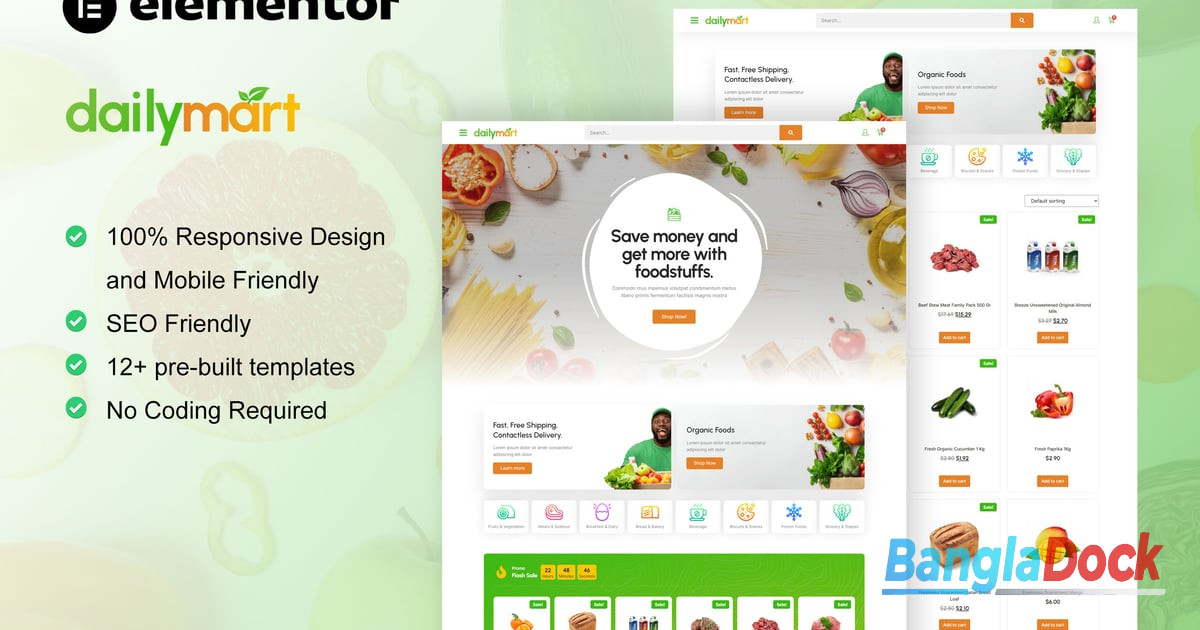
For example, a store owner building a grocery delivery website can start faster with the DailyMart – Grocery Store Elementor Template Kit, then customize product sections, homepage banners, delivery messaging, and conversion-focused landing pages using Elementor’s visual editor.
WordPress Theme Builder Comparison: Divi vs Elementor Pro
The WordPress theme builder is where many serious projects are won or lost. A modern WordPress site is rarely just a homepage and a contact page. You may need custom blog templates, WooCommerce product layouts, author pages, category archives, landing pages, and conditional templates for different content types.
Divi Theme Builder
Divi’s Theme Builder lets you design headers, footers, body templates, category pages, product templates, and other site-wide layouts. It is strong when you are working inside the Divi ecosystem and want global control over a site’s visual structure. For brand-focused business sites, portfolios, service pages, and agency websites, Divi can deliver excellent results.
Elementor Theme Builder
Elementor Pro’s Theme Builder is particularly useful when your site depends on dynamic content. You can create templates for custom post types, connect fields, assign display conditions, and combine Elementor widgets with third-party plugins. If you work with Advanced Custom Fields, custom directories, listings, review sites, event pages, or service databases, Elementor Pro usually feels more adaptable.
This is where ACF Frontend Pro For Elementor becomes especially valuable. As an illustrative example, a developer could build a property listing site where agents submit and edit listings from the frontend, while Elementor handles the listing design and ACF stores the structured data.
WooCommerce: Which Builder Is Better for Online Stores?
Both Divi and Elementor Pro can build attractive WooCommerce stores, but Elementor Pro tends to have an advantage for stores that need more granular template control and broader compatibility with conversion-focused plugins. Elementor Pro includes WooCommerce widgets for product pages, archives, add-to-cart sections, product images, ratings, pricing, upsells, and related products.
Divi also includes WooCommerce modules and can produce polished product layouts. It is a good fit for store owners who want a visually consistent shopping experience and prefer Divi’s design controls. For simple stores, Divi may be more than enough.
For serious WooCommerce optimization, the page builder is only one part of the stack. Cart speed, checkout friction, payment flow, product filtering, and trust signals matter just as much. If your store feels slow during purchase, study How to Speed Up WooCommerce Cart and Checkout Pages for Instant Loading. If your main issue is abandoned carts, compare tools in Top WooCommerce Checkout Optimization Plugins to Reduce Cart Abandonment in 2026.
Forms, Documents, and Business Workflows
Professional WordPress sites often need more than pages. They need lead forms, quote requests, onboarding forms, contracts, approval flows, and legally relevant signatures. Elementor Pro includes a capable form widget, but many businesses prefer dedicated form plugins for advanced conditional logic, payments, integrations, and addon ecosystems.
For form-heavy websites, the WPForms Pro Bundle + All Addons pairs well with either Divi or Elementor Pro. It is useful for quote forms, surveys, payment forms, newsletter signups, and CRM-connected lead capture.
For agencies, consultants, legal services, HR teams, or B2B websites that require digital agreements, WP E-Signature – Bundle with all addons can support contract and document-signing workflows directly inside WordPress. These tools are not replacements for a page builder; they extend what your finished website can actually do.
Performance and Clean Build Quality
No honest Divi vs Elementor Pro comparison should promise that one builder is automatically fast and the other is slow. Performance depends on hosting, theme quality, image optimization, plugin load, caching, fonts, database health, WooCommerce configuration, and how carefully the builder is used.
Both builders can create bloated pages if users stack too many sections, animations, sliders, icon libraries, third-party widgets, and oversized images. Both can also produce acceptable real-world performance when used carefully with a lightweight theme, optimized assets, clean templates, and sensible caching.
Developer-Oriented Performance Tips
- Start with a lean theme: Avoid combining a heavy multipurpose theme with a heavy visual layout.
- Limit widget addons: Install only the Elementor or Divi addon packs you genuinely use.
- Optimize images before upload: Use correct dimensions and modern formats where appropriate.
- Reduce animation overload: Motion effects can hurt usability and performance when used excessively.
- Test critical templates: Check homepage, product page, cart, checkout, and high-traffic landing pages individually.
Common Mistakes to Avoid When Choosing a Page Builder
- Choosing only by visual demos: Demo pages rarely reflect your real content, plugin stack, hosting, or maintenance needs.
- Ignoring dynamic content: If your site needs custom fields or custom post types, test that workflow before committing.
- Overusing templates: Template kits are helpful, but excessive imported layouts can create inconsistent design systems.
- Letting clients edit everything: Give clients controlled editing access so they do not break global layouts.
- Skipping staging tests: Always test builder updates, addon updates, and WooCommerce changes on staging first.
- Buying unknown plugin files: Use trusted sources only. Clean, virus-free GPL alternatives from reputable marketplaces reduce risk.
Troubleshooting: Diagnostic Steps for Divi and Elementor Pro Issues
When a builder layout breaks, avoid guessing. Use a structured diagnostic process so you can identify whether the problem comes from the builder, theme, plugin conflict, cache layer, custom code, or hosting configuration.
Step-by-Step Builder Troubleshooting
- Clear all cache layers: Purge WordPress cache, server cache, CDN cache, and browser cache before deeper debugging.
- Check plugin conflicts: On staging, disable non-essential plugins and reactivate them one by one.
- Switch to a default theme temporarily: This helps identify whether the theme is causing layout or script issues.
- Regenerate builder assets: Elementor and Divi both include tools for regenerating CSS or static files.
- Inspect browser console errors: JavaScript errors often reveal broken widgets, minification issues, or plugin conflicts.
- Review recent changes: Check whether the issue started after a plugin update, PHP version change, caching change, or new custom snippet.
If an Elementor page using dynamic fields stops showing content, confirm that the field group is assigned correctly, the custom post type exists, and the template display conditions are still valid. If a Divi global module updates unexpectedly across multiple pages, review whether the module was saved as global rather than local.
Best Practices for Professional WordPress Builds in 2026
- Build a design system first: Define colors, typography, spacing, buttons, form styles, and section patterns before building pages.
- Use custom fields for structured content: Avoid placing repeatable business data only inside visual layouts.
- Keep templates modular: Separate headers, footers, archives, single templates, and landing pages logically.
- Document client editing rules: Show clients which areas are safe to edit and which templates should remain untouched.
- Maintain a staging site: Test builder, theme, WooCommerce, and PHP updates before applying them to production.
- Use trusted plugin sources: Whether buying official licenses or GPL alternatives, prioritize clean files, updates, and vendor reputation.
Final Recommendation: Divi vs Elementor Pro for 2026
Choose Divi if you prefer a unified design ecosystem, want strong visual control, and are building brand websites, portfolios, small business sites, or client sites where the Divi workflow is already familiar. Divi is also a sensible option when your agency has standardized around Elegant Themes and wants repeatable design production.
Choose Elementor Pro if your project needs stronger ecosystem flexibility, custom post type templates, ACF integration, WooCommerce customization, frontend forms, template kits, and broad plugin compatibility. For many developers and agencies, Elementor Pro remains the more versatile option in a modern WordPress stack.
For BanglaDock users, Elementor becomes even more attractive when paired with affordable professional tools such as ACF Frontend Pro For Elementor, available as a 100% clean, virus-free premium GPL alternative for ৳490 with lifetime updates. Add purpose-built tools like WPForms Pro, DailyMart for niche store design, and WP E-Signature for business workflows, and Elementor Pro can support far more than page design. It can become the foundation of a complete WordPress business platform.
Frequently Asked Questions
Is Elementor Pro better than Divi Builder in 2026?
Elementor Pro is often better for developers, agencies, WooCommerce stores, and websites that rely on custom fields, custom post types, third-party integrations, and dynamic templates. Divi Builder is still a strong choice for users who prefer a unified design ecosystem and want polished visual control inside the Divi theme. The better option depends on your project type, plugin stack, client editing needs, and long-term maintenance plan.
Can I use ACF with Elementor Pro for dynamic WordPress websites?
Yes. Elementor Pro works well with dynamic content workflows, including custom fields and custom post types. For more advanced frontend editing, ACF-powered submission forms, or user-facing content management, ACF Frontend Pro For Elementor can be a useful addition. It allows developers to create frontend forms connected to ACF fields while Elementor controls the visual layout.
Which WordPress page builder is better for WooCommerce stores?
Elementor Pro usually offers more flexibility for WooCommerce stores that need custom product templates, archive layouts, landing pages, and compatibility with conversion-focused plugins. Divi can also build attractive WooCommerce stores and may be enough for simpler shops. For best results with either builder, optimize checkout speed, reduce unnecessary plugins, use clean product templates, and test cart and checkout pages carefully.