

Choosing the right theme sets the foundation for every successful WooCommerce store. A well-built eCommerce WordPress theme controls not only how your shop looks, but also how fast it loads, how easily customers check out, and how well it ranks in search engines. The following list gathers ten proven themes trusted by developers, agencies, and store owners who want a balance of design flexibility, performance, and long-term maintainability.
What Makes an eCommerce WordPress Theme Worth Using?
Before comparing individual themes, it helps to define what separates a professional storefront from a hobby template. Strong eCommerce themes share several traits: deep WooCommerce integration, mobile-first responsive layouts, page builder compatibility, clean and semantic code, translation readiness, and active developer support. Themes that meet these criteria give you room to scale without rewriting your entire front end later.
Core Technical Requirements
- WooCommerce hooks and templates properly overridden
- Ajax cart, quick view, and wishlist functionality baked in
- Schema-ready markup for product rich results
- Elementor, WPBakery, or Gutenberg support for custom layouts
- Optimized asset loading with conditional CSS and JS
The Top 10 eCommerce WordPress Themes
1. Woodmart
Woodmart is one of the most flexible WooCommerce themes available. It ships with a native theme options panel, hundreds of pre-built demos across fashion, electronics, and grocery niches, and a header builder that rivals dedicated plugins. Developers appreciate its child theme structure and clean template overrides. For a deeper look at its capabilities, review this guide on Woodmart theme easy to build your website.
2. Flatsome
Flatsome remains a long-standing favorite thanks to its UX Builder, a drag-and-drop editor tailored for shops. It offers responsive controls, quick view popups, and a lightweight core that pairs well with WooCommerce extensions. Its element library is particularly useful for product-focused landing pages.
3. Astra
Astra is a lightweight, performance-first theme popular among developers who prefer building layouts with Elementor or Spectra. Its default CSS footprint is minimal, and its Pro version adds a WooCommerce module with off-canvas filters, sales bubbles, and quick view. It works well for stores prioritizing Core Web Vitals.
4. Porto
Porto packs an extensive collection of shop demos, from B2B catalogs to marketplace layouts. It includes its own page builder alongside Elementor and WPBakery support, plus advanced product filtering and mega menu options. Its multi-vendor compatibility makes it suitable for larger inventories.
5. Shopkeeper
Shopkeeper focuses on typography-driven, editorial-style storefronts. It uses WPBakery and the WordPress block editor together, letting content teams craft product stories without touching code. The theme is well-suited for boutique brands and lifestyle products.
6. Electro
Built specifically for electronics, marketplace, and multi-vendor stores, Electro integrates seamlessly with Dokan and WC Vendors. Category-heavy navigation, comparison tables, and vertical mega menus mirror the layouts used by major retailers.
7. XStore
XStore ships with a large library of full and single-page demos plus a header and footer builder. Its built-in optimization panel helps trim unused assets, which supports better PageSpeed scores. Frequent updates and detailed documentation make it approachable for solo developers.
8. Blocksy
Blocksy is a modern, block-editor-friendly theme with a WooCommerce extension that adds quick view, product cards, and sticky add-to-cart bars. Its performance profile is excellent, and its Content Blocks feature lets you inject custom sections anywhere on the shop templates using conditional rules.
9. Savoy
Savoy is a minimalist, Ajax-powered WooCommerce theme designed around speed and product clarity. Nearly every interaction — filtering, pagination, cart updates — happens without a full page reload, which keeps users engaged during browsing.
10. DailyMart
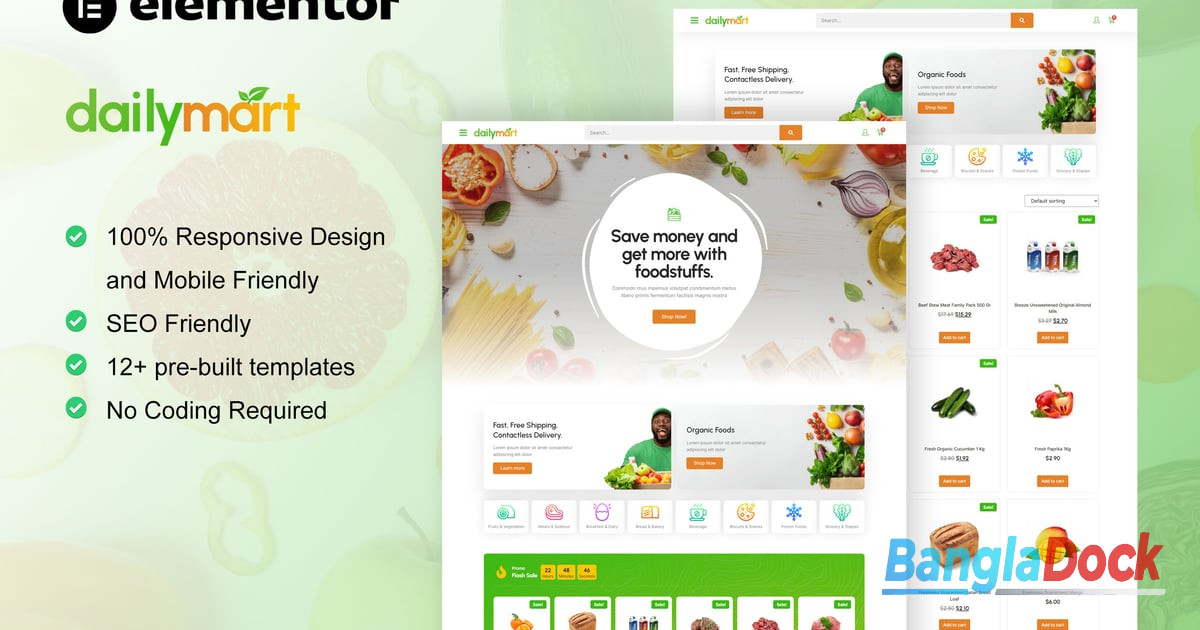
For grocery and daily-essentials shops, the DailyMart – Grocery Store Elementor Template Kit delivers a category-first layout with time-slot delivery blocks, promotional banners, and mobile-friendly product grids. It pairs well with any Elementor-compatible base theme.
For clean, licensed downloads of premium themes and add-ons like these, BanglaDock offers a curated library of GPL WordPress products with regular updates.
Real-World Use Cases
The right theme depends on your product catalog and customer journey. A few illustrative scenarios help clarify the fit:
- Fashion boutique with 200 SKUs: Flatsome or Shopkeeper for editorial visuals and lookbook layouts.
- Electronics marketplace with vendors: Electro or Porto for comparison, filter-heavy navigation, and vendor dashboards.
- Grocery store with daily promotions: DailyMart layouts on a lightweight base like Astra or Blocksy.
- Affiliate-driven store: Astra or Blocksy paired with the AffiliateWP Multi-Tier Commissions Addon for referral programs.
- High-volume coupon campaigns: Any theme combined with the WooCommerce Customer Order Coupons CSV Import Suite for bulk discount management.
Troubleshooting Common Theme Issues
Even the best-coded theme can misbehave when combined with the wrong plugins or server configuration. Work through the diagnostic steps below before contacting support.
Slow Front-End Performance
- Disable unused theme modules from the options panel.
- Audit which CSS and JS files load on non-shop pages using browser dev tools.
- Enable a caching plugin and defer non-critical scripts.
- Confirm images use next-gen formats such as WebP.
Broken WooCommerce Templates After Updates
- Check for outdated template overrides inside your child theme's woocommerce folder.
- Compare template versions in the WooCommerce status report.
- Refresh permalinks under Settings → Permalinks after updating.
Layout Conflicts with Page Builders
- Disable third-party addons one at a time to isolate the source.
- Rebuild affected sections using native theme widgets.
- Clear both the builder cache and the site cache after changes.
Common Mistakes to Avoid
- Activating every demo import at once, which leaves orphaned pages and bloated media libraries.
- Editing parent theme files directly rather than using a child theme, causing lost changes on updates.
- Ignoring accessibility settings such as color contrast and keyboard navigation.
- Installing overlapping plugins that duplicate wishlist, quick view, or mega menu features already included in the theme.
- Skipping staging tests before pushing theme updates to a live store.
Best Practices for Deploying an eCommerce Theme
- Set up a child theme immediately after activation.
- Import only the demo that matches your final design direction.
- Audit Core Web Vitals with real device testing, not just synthetic tools.
- Enable structured data for products, reviews, and breadcrumbs.
- Document custom hooks and filters used to modify WooCommerce templates.
- Maintain a staging environment mirroring production for safe updates.
- Review changelogs before every theme update to catch breaking changes.
Matching a Theme to Your Store's Growth Stage
Early-stage shops benefit from lightweight, modular themes like Astra or Blocksy that let you extend features as you learn what customers want. Established stores with complex catalogs lean toward Woodmart, Porto, or Electro because those themes ship with the advanced filtering, mega menus, and vendor support that scale demands. For niche verticals like grocery or daily essentials, purpose-built kits shorten launch time considerably — a pattern explored further in this roundup of the Top 10 Digital Marketplace & Grocery Store WordPress Theme options.
Whichever theme you pick, treat it as the starting point of an ongoing optimization cycle rather than a finished product. Track conversion patterns, refine layouts, and keep dependencies current so your storefront stays fast, secure, and aligned with buyer expectations.
Frequently Asked Questions
Which eCommerce WordPress theme is best for beginners?
Astra and Blocksy are strong choices for beginners because both offer clean interfaces, lightweight performance, and full compatibility with Elementor and the WordPress block editor. They provide starter templates that let new store owners launch quickly without deep coding knowledge, while still giving developers room to customize using hooks and filters.
Do these themes work with any WooCommerce extension?
Most premium eCommerce themes on this list follow WooCommerce coding standards, so they generally work with popular extensions such as subscriptions, bookings, multi-vendor plugins, and affiliate tools. Always review the theme's compatibility notes and test extensions on a staging site before deploying updates to a live store.